
Use of English Part 2 Open Cloze Tips and Tricks
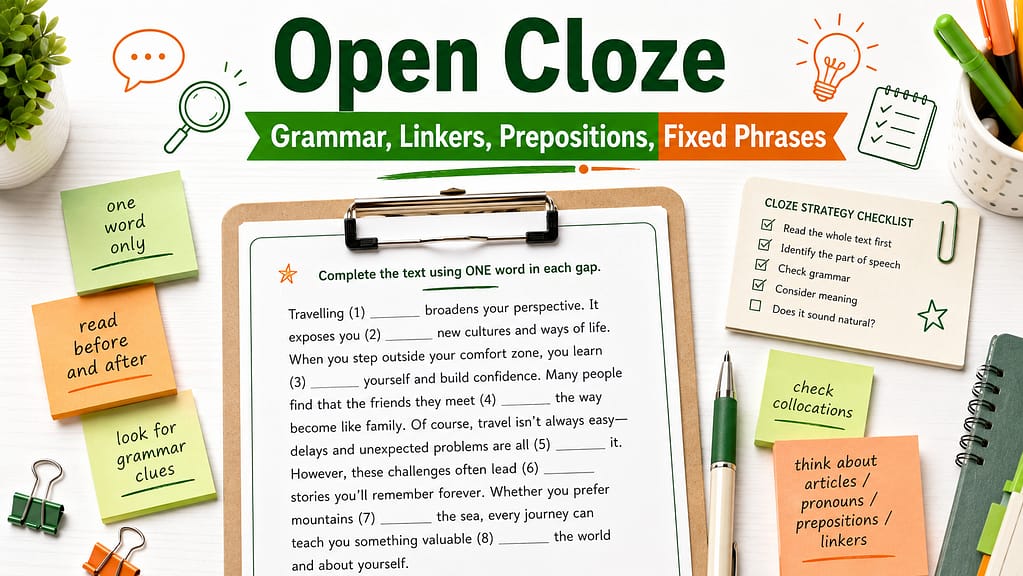
What is Use of English Part 2 Open Cloze?
Use of English Part 2, usually called Open Cloze, is one of the most important grammar-focused tasks in the Cambridge English exams.
You are given a short text with missing words. For each gap, you must think of the missing word yourself. There are no options to choose from. The answer must be one single word.
This exercise appears in B2 First/FCE, C1 Advanced/CAE and C2 Proficiency/CPE.
Although the level changes, the basic task remains the same: you need to read the text carefully and complete each gap with the word that best fits the grammar, meaning and structure of the sentence.
Why is Open Cloze difficult?
Open Cloze is difficult because the missing words are usually small grammar words, not impressive vocabulary items.
Students often expect the answer to be a “big” word: a noun, adjective or advanced verb. In reality, the missing word is often something like:
- a preposition
- an auxiliary verb
- an article
- a pronoun
- a linker
- part of a fixed expression
- part of a comparison
- a small negative word
These words may look simple, but they are structurally important. Without them, the sentence does not work properly. For example:
- She is very good ___ explaining complicated ideas clearly.
The missing word is not a difficult piece of vocabulary. The answer is at, because the structure is good at doing something.
That is the essence of Open Cloze: it tests whether you can see how English sentences are built.
What kinds of words are tested?
Open Cloze usually tests grammar and lexico-grammar. This means that the answer may depend on grammar, but it may also depend on a fixed phrase, a dependent preposition or a common language pattern.
Here are the main categories to watch for.
1. Pronouns and Relative Pronouns
Pronouns are common in Open Cloze because they help connect ideas across a sentence or text. Relative pronouns, which replace ordinary pronouns to connect sentences together and extend discourse, are also commonly tested,
Typical answers include:
- who
- which
- that
- where
- when
- whose
- it
- they
- them
- one
- something
- anything
Example:
This is the village ___ my grandparents lived for many years.
Answer: where
To answer this type of question, look carefully at the noun before the gap and the structure after the gap.
2. Articles and Determiners
Articles and determiners are small but essential. They define or limit the noun that follows.
Common answers include:
- a
- an
- the
- this
- that
- these
- those
- some
- any
- no
- much
- many
- few
- little
- each
- every
- all
- both
Example:
- There was ___ little time left that we had to leave immediately.
The answer is so.
This example also shows why you should not think about word categories too mechanically. The word after the gap matters, but the wider structure matters too: so little … that.
3. Prepositions
Prepositions are one of the most frequent areas tested in Open Cloze.
They may be prepositions of time, place or movement:
- in
- on
- at
- during
- through
- across
- between
They may also be dependent prepositions after verbs, adjectives or nouns:
- interested in
- good at
- depend on
- responsible for
- aware of
- similar to
- different from
- the reason for
- an increase in
For example:
- The company is responsible ___ maintaining the equipment.
The answer is for.
The best way to learn these is not as isolated words, but as complete patterns: responsible for doing something, interested in something, depend on someone.
4. Linkers and conjunctions
Open Cloze often tests how ideas are connected.
Common answers include:
- although
- because
- as
- since
- while
- whereas
- if
- unless
- whether
- but
- and
- so
- nor
It can also test two-part structures:
- either … or
- neither … nor
- not only … but also
- both … and
- whether … or
Example:
- I do not know ___ she will accept the offer or not.
The answer is whether.
When you see a gap near two clauses, ask yourself: What is the logical relationship? Contrast? Reason? Condition? Alternative? Addition?
5. Auxiliary and modal verbs
Auxiliary verbs are used to form tenses, questions, negatives, passives and emphatic structures.
Common answers include:
- be
- am
- is
- are
- was
- were
- been
- have
- has
- had
- do
- does
- did
Modal verbs may also appear:
- can
- could
- may
- might
- must
- should
- would
Example:
- The report has ___ completed and will be published tomorrow.
Answer: been
Here the structure is the present perfect passive: has been completed.
6. Fixed expressions and phrasal verbs
Some answers come from fixed expressions or phrasal verbs. In these cases, the missing word is often a small structural word inside a larger phrase.
Examples of fixed expressions:
- at times
- by means of
- on the other hand
- in fact
- as a result
- in spite of
- with regard to
Examples of phrasal verb patterns:
- look forward to
- put up with
- come across
- bring about
- carry on
- find out
Example:
I am looking forward ___ seeing you next week.
Answer: to
The answer is not just a preposition. It is part of the fixed pattern look forward to doing something.
7. Comparisons
Comparative structures are another common area.
Useful patterns include:
- as … as
- not as … as
- more … than
- less … than
- rather than
- the same as
- such … as
- so … that
- too … to
- enough to
Example:
The journey was not as long ___ I had expected.
Answer: as
Whenever you see a comparative adjective, an intensifier or a word like so, such, too, enough, more or less, check whether the sentence is part of a comparison or result structure.
8. Negative structures
Negative words can change the whole meaning of a sentence.
Common answers include:
- not
- no
- never
- neither
- nor
- hardly
- scarcely
Example:
He neither apologised ___ offered to pay for the damage.
Answer: nor
Two-part negative structures are especially important at higher levels.
How to approach Open Cloze in the exam

A good method is more reliable than simply guessing.
Step 1: Read the title and the whole text first
Do not start filling the gaps immediately. First, read the title and the whole text quickly. This gives you the topic, tone and general meaning.
Some answers depend only on the immediate sentence. Others depend on the wider paragraph or the whole text.
Step 2: Read the complete sentence around the gap
Read before and after the gap. The words after the gap are often just as important as the words before it.
Ask:
- Is the gap followed by a noun?
- Is it followed by an -ing form?
- Is it followed by an infinitive?
- Is it part of a relative clause?
- Is it part of a comparison?
- Is it part of a fixed expression?
Step 3: Identify the grammar pattern
Try to name the structure.
For example:
- passive form
- relative clause
- conditional clause
- comparison
- dependent preposition
- phrasal verb
- fixed phrase
- negative structure
- quantifier + noun
- article + noun
You do not need complicated terminology in the exam, but you do need to recognise the pattern.
Step 4: Check meaning and grammar together
A word may be grammatically possible but wrong in meaning. Another word may make sense but not fit the grammar.
The correct answer must satisfy both conditions:
- It must fit the grammar.
- It must fit the meaning of the text.
Step 5: Use only one word
Open Cloze answers must be one word. Do not write a phrase. Do not write two possible answers. Avoid contractions such as don’t, isn’t or he’ll; use the full form if needed.
Step 6: Check spelling
Spelling matters in Use of English. Even if you have chosen the correct word, you can lose the mark if it is misspelled.
This is especially important with words such as:
- whether
- although
- whose
- enough
- neither
- through
- though
Common mistakes in Open Cloze
Mistake 1: Looking only before the gap
Many students read only the words before the gap. This is risky. The words after the gap often control the answer.
Example:
She was accused ___ taking the documents.
The answer is of, because the pattern is accuse someone of doing something.
Mistake 2: Writing more than one word
If the answer is one word, do not write two. For example, if the gap needs although, do not write even though.
Mistake 3: Choosing a word that sounds natural but breaks the structure
A word may sound generally possible but fail grammatically.
Example:
I am not used ___ getting up so early.
The answer is to, not for, because the structure is be used to doing something.
Mistake 4: Ignoring the text as a whole
Some answers refer back to people, things or ideas already mentioned.
Example:
The scientist published her findings in 2018, ___ caused considerable debate.
Answer: which
Here, which refers to the whole previous idea, not just one noun.
Mistake 5: Treating Open Cloze as a vocabulary test
Part 2 is not mainly about showing off advanced vocabulary. It is about control of sentence structure. The missing word is often simple, but the reason for it is precise.
Use of English Part 2 Open Cloze Tips and Tricks; how to prepare
The best preparation is to study grammar in short, reusable patterns, or language chunks.
Instead of learning only the meaning of words like interested, learn interested in something or interested in doing something
Other examples are:
although + clause,
Example: although it was difficult, we continued
adjective + enough + to OR enough + noun + to
Examples:
My project was good enough to get top marks.
Do you have enough money for this holiday?
For Open Cloze, useful revision areas include:
- articles
- quantifiers
- dependent prepositions
- relative clauses
- auxiliary verbs
- modal verbs
- passive forms
- conditionals
- comparison structures
- linkers
- fixed expressions
- phrasal verbs
- negative structures
A practical study routine
Try this simple routine with any Open Cloze practice text.
- Complete the task under timed conditions.
- Check your answers.
- For every mistake, write down the full phrase or structure, not just the missing word.
- Create a short example sentence of your own.
- Review your mistake list before doing the next practice test.
For example, if the answer was of in aware of, do not only write:
of
Write:
be aware of somethingShe was aware of the problem.
This turns each mistake into useful language.
Use of English Part 2 Open Cloze Tips and Tricks; Final advice
Open Cloze rewards accuracy, not guessing. The missing words are usually small, but they carry a lot of grammatical weight.
When you practise, train yourself to look for patterns:
- What comes before the gap?
- What comes after the gap?
- What structure is being tested?
- What meaning does the sentence need?
- Is the answer definitely one word?
If you approach the exercise this way, Use of English Part 2 becomes much less mysterious. It is not a test of random missing words. It is a test of how well you understand the structure of English.