
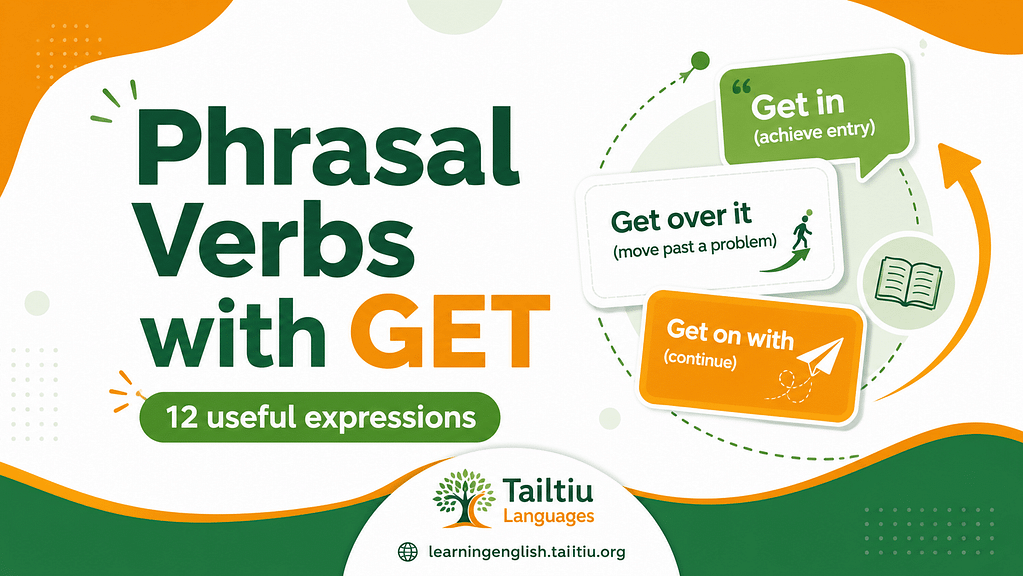
Phrasal Verbs with GET
Useful Expressions to Learn
Here we present a few phrasal verbs with get, a widely-used verb in the English language. Get is one of the most useful verbs in English — and one of the most flexible. Combine it with a preposition or adverb and its meaning can change completely.
Here are some useful examples:
- get by – manage with what you haveI don’t earn much, but I get by.
- get ahead – become more successfulYou need experience to get ahead in this industry.
- get at – mean or imply somethingWhat exactly are you getting at?
- get back – returnWe got back home at midnight.
- get in – enter or be acceptedShe got in to her first-choice university.
- get on – make progressHow are you getting on with your new course?
- get on with – have a good relationship with someoneI get on well with my colleagues.
- get over – recover from something difficultIt took him a while to get over the disappointment.
- get down to business – start dealing seriously with somethingEnough chatting — let’s get down to business.
- get about – move or travel from place to placeHe’s 80, but he still gets about easily.
And when your team scores an important goal, you might even hear someone shout the footballing term:
“Get in!”
Practise them
Knowing the meaning of a phrasal verb is only the first step. The real aim is to recognise it quickly and use it naturally.
Try the C1 practice exercise below on phrasal verbs with get, check your score, then use the speaking activity to recycle the expressions in your own sentences.
Phrasal Verbs with GET
Review some common and useful phrasal verbs and expressions with get.
- 1. Although he doesn't earn much money, he manages to get quite comfortably.
- 2. If you really want to get in this profession, you need both qualifications and experience.
- 3. I'm not quite sure what you're getting . Are you saying that we should cancel the whole project?
- 4. There's no need to keep getting him about his appearance. You're only going to upset him.
- 5. We didn't get from the concert until nearly two in the morning.
- 6. Our team scored the winning goal in the final minute. Everyone jumped up and shouted, "Get !"
- 7. She applied to several universities, but fortunately she managed to get to her first choice.
- 8. I haven't seen you since you started the new job. How are you getting ?
- 9. I generally get on my colleagues, although we disagree from time to time.
- 10. I know you're disappointed about what happened, but eventually you'll have to get it.
- 11. We've spent twenty minutes chatting about football. Perhaps we should get to business.
- 12. My grandfather is nearly eighty-five, but he still gets quite a lot and regularly visits friends in other parts of town.
- 13. She found the course difficult at first, but she's getting much better now.
- 14. It's difficult to get in a competitive company unless you're prepared to take on more responsibility.
- 15. He was furious when they rejected his application, but after a few days he got it and started looking for other opportunities.
Get Talking
Work with a partner. Respond naturally to each situation using an appropriate expression with get. Then ask a follow-up question.
Extension
Choose five of the expressions from the exercise and create a personalised question for your partner using each one.
For example:
How easy would it be for you to get by on half your
present income?
What do you think is the best way to get ahead in your
profession?
Who do you get on with particularly well?