B2 Phrasal Verbs Revision
Build up your vocabulary bank for B2 and C1 English with our B2 Phrasal Verbs Revision App
Phrasal verbs are one of the most important areas of vocabulary for B2 English learners. They appear constantly in natural English, in conversation, in reading texts, and in exam-style tasks. They are also one of the areas that can make the difference between “correct” English and more fluent, confident English.
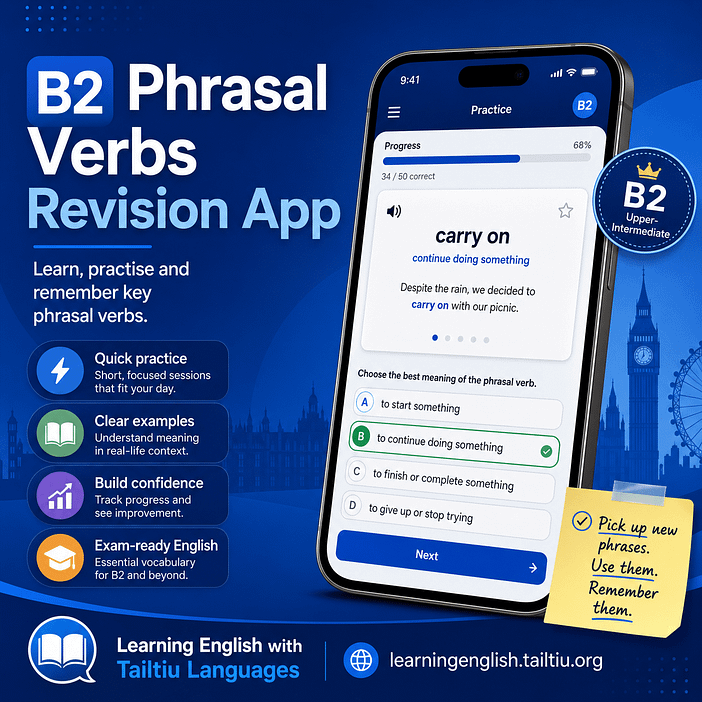
This B2 Phrasal Verbs Revision App is designed to help learners revise, practise and remember useful phrasal verbs through short, focused activities. It is especially useful for learners working around the B2 / upper-intermediate level who want to strengthen their vocabulary and begin moving towards C1.
You can start using it now, or scroll down to learn how to use it most effectively.
Why Practise Phrasal Verbs?
A phrasal verb is usually made from a verb plus a particle, such as up, out, on, off, over or through. That particle can completely change the meaning of the verb. For example:
- give up = stop trying
- find out = discover information
- carry on = continue
- put off = postpone
- work out = understand, calculate or solve
This is why phrasal verbs need more than simple memorisation. Learners need to see them in context, practise their meanings, and gradually build a personal bank of examples.
In exam preparation, phrasal verbs also connect closely with wider language areas such as fixed expressions, dependent prepositions and multi-word structures. Phrasal verb particles are the adverb or preposition that changes the meaning of the base verb, and that more advanced levels introduce more complex phrasal verbs and multi-word phrases as well as metaphorical sense in these expressions.
What the B2 Phrasal Verbs Revision App Helps You Do
The app is designed for quick, regular revision. Instead of trying to learn long lists of phrasal verbs in one session, learners can practise in shorter stages and return to difficult items repeatedly.
With the app, you can:
- revise key B2 phrasal verbs
- check meanings through short examples
- practise choosing the correct meaning
- notice how particles change meaning
- build confidence before moving towards C1 vocabulary
- add your own example sentences for extra practice
This makes the app useful both for independent learners and for students preparing for upper-intermediate English classes or exam-style vocabulary work.
How to Use the B2 Phrasal Verbs Revision App
Start by choosing a small number of phrasal verbs to revise. Do not try to learn too many at once. A good target is 5–10 phrasal verbs per study session.
For each phrasal verb, follow this simple method:
- Read the phrasal verb
Look carefully at the verb and the particle. For example: pick up, carry on, look into, put off. - Check the meaning
Do not only translate it. Try to understand the meaning in English. - Read the example sentence
Example sentences show how the phrasal verb works in real communication. - Practise actively
Use the app activity to test yourself. Try to choose the correct meaning before checking the answer. - Add your own example
This is an important step. Your own sentence helps move the phrasal verb from passive recognition into active vocabulary.
For example:
Phrasal verb: carry on
Meaning: continue
App example: Despite the rain, we decided to carry on with our picnic.
Your example: I was tired, but I carried on studying because the exam was next week.
Add Your Own B2 Examples
There is no reason to stop with the examples already in the app. In fact, adding your own sentences is one of the best ways to use it.
When you add an example, keep it:
- realistic
- personal where possible
- grammatically clear
- connected to situations you might actually talk or write about
For example:
put off
I put off doing my homework until Sunday evening.
find out
I found out about the course from a friend.
run out of
We ran out of time before we could finish the activity.
look forward to
I am looking forward to starting my new English course.
This turns the app into a personal vocabulary notebook, not just a revision tool.
From B2 to C1: Building a Stronger Vocabulary Bank
At B2 level, learners usually need common, practical phrasal verbs for everyday and exam-style English. At C1, the challenge becomes greater. Learners need to understand more subtle meanings, more formal and informal choices, and more complex multi-word expressions.
The app can help bridge that gap. Once you know a B2 phrasal verb, you can start extending it.
For example:
| B2 phrasal verb | Basic meaning | C1-style extension |
|---|---|---|
| find out | discover | find out whether / find out how / find out the extent to which |
| put off | postpone | be put off by something / put someone off doing something |
| carry on | continue | carry on regardless / carry on with a long-term plan |
| come up with | think of an idea | come up with a convincing explanation |
| look into | investigate | look into the causes of a problem |
This is how vocabulary develops: not by learning one isolated meaning, but by building a wider network of examples, collocations and contexts.
A Simple Weekly Study Plan
To use the app effectively, try this routine:
Monday/Day 1: Learn 5 new phrasal verbs.
Tuesday/Day 2: Revise them and add your own examples.
Wednesday/Day 3: Test yourself without looking at the meanings.
Thursday/Day 4: Add 5 more phrasal verbs.
Friday/Day 5: Mix old and new items together.
Weekend: Write a short paragraph using 5–8 phrasal verbs naturally.
For example, you could write about your studies, work, travel plans, hobbies or exam preparation. The aim is not to force phrasal verbs into every sentence, but to use them accurately where they fit.
Final Tip
The best way to learn phrasal verbs is through repeated, meaningful contact. Do not simply read a list once and expect to remember it. Use the app regularly, review older items, add personal examples, and gradually build your own B2-to-C1 vocabulary bank.
Our B2 Phrasal Verbs Revision App is a practical tool for learners who want to move beyond basic vocabulary and develop more natural, flexible English.