

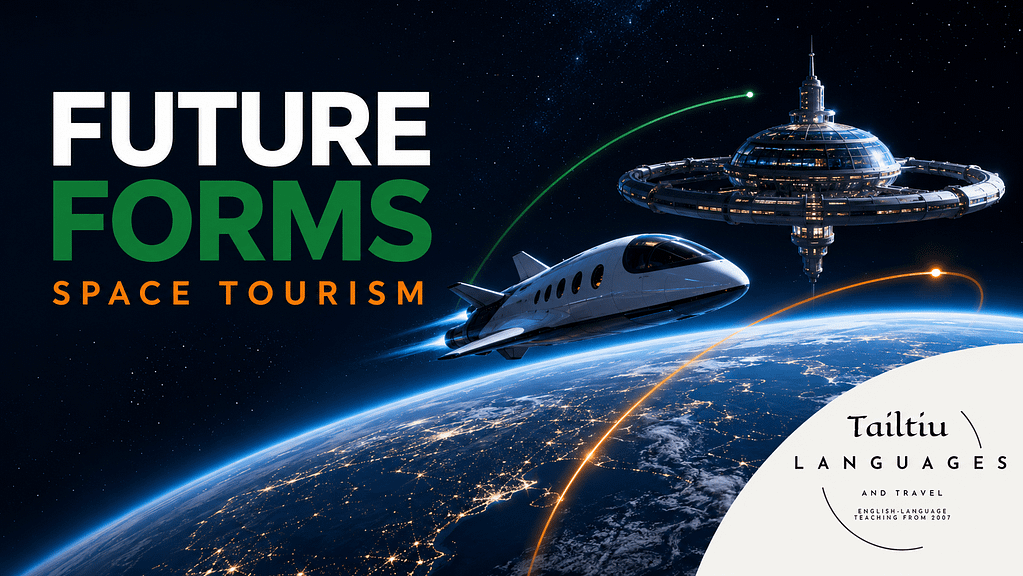
Five Ways to Talk About the Future
English has several future forms because we do not always view the future in the same way. Sometimes we feel confident, sometimes we see evidence, and sometimes we are simply describing a possibility. Here are five ways to talk about the future for making predictions and discussing future developments.
1. Will: predictions and personal opinions
Use will + base verb when you are making a general prediction, especially one based on your opinion or belief.
- Space tourism will become more affordable.
- I think people will live on Mars one day.
- It won’t replace ordinary holidays.
Words such as think, believe, expect, probably and definitely often appear with will.
I think space hotels will be popular.
Will is also common for decisions made at the moment of speaking:
“Who wants to present first?” “I’ll do it.”
2. Be going to: evidence and existing intentions
Use am/is/are going to + base verb when there is present evidence that something will happen.
- Ticket prices are falling, so space travel is going to become more accessible.
- Look at those dark clouds! It’s going to rain.
We also use it for intentions or plans decided before speaking:
The company is going to build a new space station.
The key question is: Is there evidence now, or has somebody already made the decision? If so, going to is often the best choice.
3. May, might and could: future possibilities
Use may, might or could + base verb when something is possible but uncertain.
- Space hotels may become common.
- Tourists might travel around the Moon.
- Reusable rockets could reduce costs.
In predictions, these forms often have very similar meanings. Might can sometimes sound slightly less certain, but the difference is not always important.
For negative possibilities, use may not or might not:
Ordinary families might not be able to afford space travel.
Be careful: couldn’t usually means that something would be impossible, not simply that it possibly will not happen.
4. Be likely to: probable developments
Use am/is/are likely to + base verb when you believe something will probably happen.
- Prices are likely to fall.
- Early space hotels are likely to attract wealthy tourists.
- Space travel is unlikely to become affordable immediately.
Likely to expresses more confidence than may, might or could, but it is not a guarantee.
5. Be set to: planned or officially expected events
Use am/is/are set to + base verb for developments that are arranged, announced or strongly expected.
- A new space station is set to open in 2030.
- The company is set to launch its rocket next year.
This form is common in news reports and business writing. It sounds more official than going to, but it still does not mean 100% certainty—plans can change.

Quick choice
Ask yourself:
- Is it my prediction or opinion? → will
- Is there present evidence or a previous decision? → going to
- Is it only possible? → may, might, could
- Is it probable? → likely to
- Is it officially planned or expected? → set to
The future is uncertain—but your grammar doesn’t have to be! These five ways to talk about the future should help you make what is coming more certain and clear.
Future Forms: Space Tourism
Choose the best future form for each prediction, possibility or planned development.
How to play: Select a phrase from the word bank, then select the gap where it belongs. Select a completed gap to clear it. Use every phrase once.
Future-form word bank
Use the sentence context and the visible meaning cue. Each phrase has one intended position.
0 / 20 gaps completed.
Need the answer sheet?
Try the exercise and check your score before revealing the full answer key.
Future forms: answers
Notice how each form expresses a different view of the future.
Resources
Five Ways to Talk about the Future 1
Five_Ways_to_Talk_About_the_Future_Exercise
Five Ways to Talk about the Future 2
Five_Ways_to_Talk_About_the_Future_Reference_Article_and_Answers